How to Register Van as a Motor Caravan with the DVLA
If you want to register van as motor caravan with the DVLA, the conversion itself is only part of the process.
Getting the DVLA to change the body type on the V5C registration certificate to “motor caravan” requires the finished vehicle to meet specific requirements and for you to provide the correct evidence.The DVLA will only consider changing the body type if the completed vehicle meets both the required internal features and the permanent external features expected of a motor caravan.
This guide explains, step by step, what your converted van needs, what photographs and paperwork to provide, how to complete the V5C, and what happens after you send your application to the DVLA.
It is also worth knowing that your van can still be used as a camper even if the DVLA does not change the body type to “motor caravan”, provided the converted vehicle meets the required internal features and is safe to use.
Does Your Van Qualify as a Motor Caravan?
For the DVLA to consider changing the body type on your V5C to “motor caravan”, the finished vehicle needs to look and function like a motor caravan.
The DVLA currently expects the vehicle to have both the required internal living features and recognisable permanent external features.
Required internal features
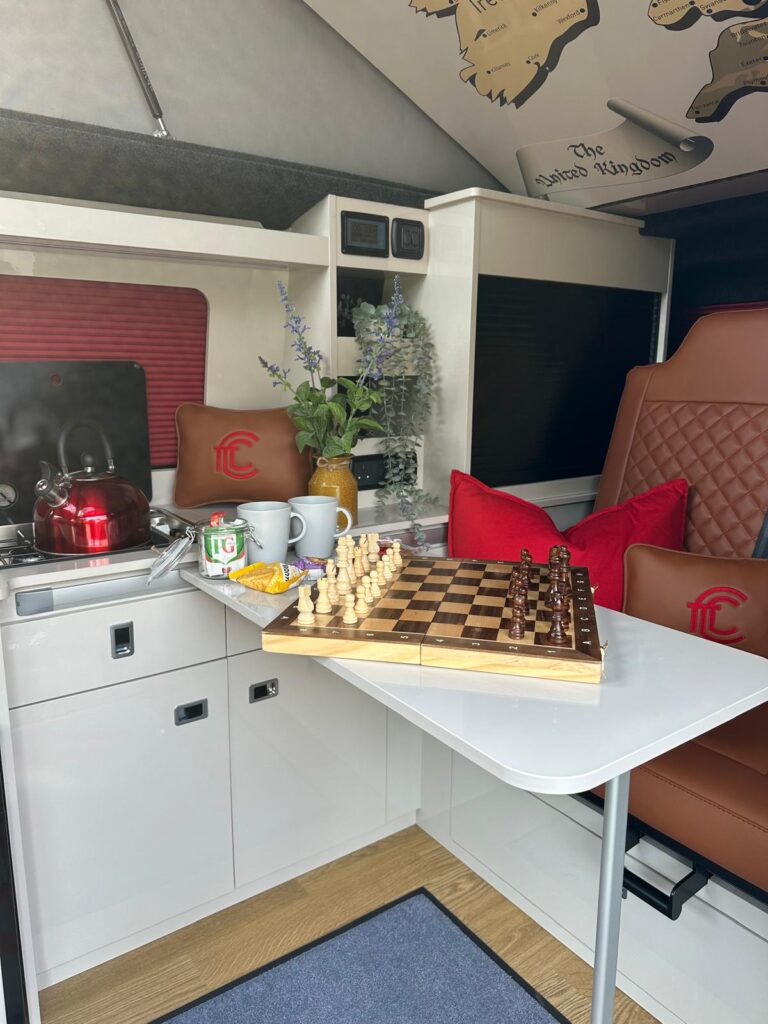
The living area must include all four of the following:
- seats and a table
- sleeping accommodation, which may be converted from the seats
- cooking facilities
- storage facilities
These items must be permanently fixed to the living compartment, although the table itself may be removable provided its mounting arrangement is permanently installed.
Permanent external features
For a body-type change, the DVLA currently expects to see features such as:
- two or more windows on at least one side of the main body, excluding the cab doors
- a separate door providing access to the living accommodation
- a high-top roof or pop-top elevating roof
The key point is that the completed vehicle should be clearly identifiable as a motor caravan when seen in normal traffic.
If the vehicle does not meet these requirements, the DVLA may leave the body type on the V5C unchanged even though the vehicle is being used as a camper.
What Evidence Do You Need to Send to the DVLA?
The DVLA requires clear evidence that the conversion is complete and that the vehicle is permanently fitted out as a motor caravan.
You should send:
- a completed V1006 Motor Caravan Conversion Checklist
- interior photographs showing each of the required living features
- exterior photographs showing the front, rear and both sides of the vehicle
- a photograph of the vehicle identification number (VIN) or chassis number
- your completed V5C registration certificate
Your interior photographs should clearly show:
- the seats and table in their usable position
- the sleeping accommodation
- the cooking facilities
- the storage facilities
- two or more windows providing daylight into the living accommodation on at least one side of the vehicle
Your exterior photographs should show the whole vehicle from:
- the front
- the rear
- the passenger side
- the driver side
The registration plates must be clearly visible in the exterior photographs.
On the back of each photograph, write:
- what the photograph shows
- the date
- the vehicle registration number
The DVLA does not automatically return photographs, so if you want them back you should ask for this in your application.
How to Complete the V5C
If your conversion is complete and you want the DVLA to change the body type to motor caravan, you need to update your V5C registration certificate.
If you have a newer-style V5C with multi-coloured numbered blocks on the front cover, complete section 1.
If you have the older-style V5C, complete section 7.
Enter the new body type as:
Motor caravan
Make sure you also include any other changes to the vehicle that need to be recorded on the V5C, such as the number of permanently fitted travelling seats.
Send the completed V5C together with your photographs and supporting evidence to:
DVLA
Swansea
SA99 1BA
Make sure you use the correct postage.
The DVLA may accept the change from the evidence you provide, or they may decide that the vehicle needs to be inspected before updating the record.
If your application is accepted, the DVLA will issue a replacement V5C showing the updated body type.
How Long Does It Take?
Because a motor caravan body-type change has to be sent to the DVLA by post with supporting evidence, it is not an instant process.
As a general guide, the DVLA says a replacement V5C sent by post will usually arrive within around 4 weeks.
If the DVLA decides that it needs to inspect the vehicle or asks for further evidence, the process can take longer.
If you have not received your replacement V5C after 4 weeks, contact the DVLA to check the progress of your application.
It is sensible to keep copies or photographs of everything you send, including your completed V5C, the V1006 checklist and all of the supporting photographs.
What Happens If the DVLA Refuses the Change?
IIf the DVLA decides that your vehicle does not meet the requirements for the body type to be changed to motor caravan, it may leave the existing body type unchanged on the V5C.
That does not necessarily mean that the vehicle cannot be used as a camper.
A converted van can still be used for camping even if the V5C continues to describe it as something such as a panel van, provided the conversion itself is safe and the vehicle meets the relevant requirements for its use.
If your application is refused, read the DVLA’s explanation carefully. In some cases, the problem may simply be that the photographs did not clearly show the required features or that the vehicle did not look sufficiently like a motor caravan externally.
If you later make further permanent changes to the vehicle, you can apply again with updated evidence.
Regardless of what body type appears on the V5C, you must make sure the vehicle is insured correctly for its converted use. Tell your insurer about the campervan conversion and any significant modifications. In many cases, a specialist campervan or motorhome insurer will be better equipped to cover a converted vehicle properly than a standard van insurer.
Common Reasons Applications Are Refused
Common reasons a motor caravan body-type application may be refused include:
- the vehicle does not clearly look like a motor caravan from the outside
- the required internal features are missing or not permanently fitted
- the photographs do not clearly show all of the required features
- the exterior photographs do not clearly show the whole vehicle from the front, rear and both sides
- the registration plates are not visible in the exterior photographs
- the VIN or chassis number has not been photographed clearly
- the V1006 Motor Caravan Conversion Checklist has not been completed and included
- the conversion is incomplete when the application is made
- the vehicle has an original body or structure that is so distinctive that the DVLA considers the existing body type to remain the most accurate description
If your application is refused, do not assume that is the end of the matter. Check the reason given by the DVLA and make sure your evidence clearly demonstrates all of the required features.
If your vehicle meets the requirements and you believe the decision is incorrect, you can ask the DVLA to review the application.
DVLA Motor Caravan Checklist
Before sending your application to the DVLA, check that you have:
- completed the campervan conversion
- fitted the required seats and table
- provided sleeping accommodation
- fitted permanent cooking facilities
- fitted permanent storage
- added the required external motor caravan features
- taken clear photographs of the interior
- taken clear photographs of the front, rear and both sides of the vehicle
- photographed the VIN or chassis number
- made sure the registration plates are visible in the exterior photographs
- completed the V1006 Motor Caravan Conversion Checklist
- completed the relevant section of the V5C
- included any other changes that need to be recorded, such as the number of permanently fitted travelling seats
- kept copies of everything you are sending
Once you are happy that everything is complete, send the application to the DVLA and wait for the updated V5C or any further instructions.
Final Thoughts
Registering a converted van as a motor caravan is mainly about making sure the finished vehicle clearly meets the DVLA’s requirements and that your application includes good evidence.
Take your time with the photographs, complete the paperwork carefully and make sure any other changes to the vehicle are also recorded correctly.
Even if the DVLA does not change the body type on the V5C, the vehicle can still be used as a camper provided it is safe, correctly insured for its converted use and complies with the relevant requirements.
If you are planning a conversion and would rather use a professional, many experienced van converters will also help with the DVLA motor caravan registration process and can advise on the evidence and paperwork needed once the conversion is complete.
You can browse Van-Converters.co.uk to find van conversion and campervan conversion specialists throughout the UK.